 We are very grateful to Phil Bowden, grandson of Walter Chapman, for driving across two counties on a wet autumn night to attend a talk we were giving on the Inspiring Souls project in the village hall. He brought along his mother’s album featuring photographs of her father, Walter, and his extended family, and which also included images of two more village men who survived the war – we were so thrilled!
Phil subsequently sent us scanned images from the album together with some very interesting and entertaining family stories and anecdotes as told to him by his mother Mildred, known in the family as Millie – and many of these are included here.
Walter was born to Martha (nee Downes) and Fred Chapman, a farm labourer, in Carleton Rode on the 4th December 1885 and he was baptised in All Saints’ Church the following month.
The Chapman’s story before they arrived in the village is intriguing. It is a fairly common surname in the surrounding area, and there are several family trees on genealogy websites with inaccurate ‘branches’. After painstakingly checking all the available documents, we believe the following to be true.
Fred Chapman (Walter’s father) was born in New Buckenham, the illegitimate son of Hannah Ruddock. His birth was registered, and he was also baptised (described as ‘base born’) as Fred Ruddock, in the spring of 1862; his granddaughter Millie knew his birthday to be the 26th April 1862 – so that fits. By the next census, aged 9, Fred was still living in the village but is now recorded as the adopted son of Amos and Mary Ann Briggs – and his surname had been changed to Chaplin. We are unsure of the connection at present.
Fred would have left school aged 10 or 11. At this time, school attendance wasn’t compulsory, and it wasn’t free – so most children worked from a very young age to supplement the family income. Both of Fred’s adopted parents were ageing agricultural labourers; Fred followed Amos into working with horses.
At some point between the 1871 and 1881 (census evidence), Fred changed his name to Chapman – but the reasons are as yet unclear (his adoptive parents are both still alive on the 1881 census in New Buckenham; Amos died in 1888 but Mary Ann is still there on the 1891 census).
Fred left New Buckenham and became groom to the Rector of Eccles who lived in the Manor House in Old Buckenham, and this is where he met Martha Downes who was employed as a live-in servant.
Fred and Martha married in 1881 and had their first child, Frederick, later that year. They moved to Carleton Rode around 1884 and four more children were born. So, to put them in order: Frederick, Edith, Walter, Arthur and Herbert. Sadly, Martha died prematurely in 1893 aged only 31.
Life must have been difficult for Fred, raising five children who were aged between 3 and 11 when their mother died. So, what happened to them?
The oldest boy, Frederick, would have left school at 11 but he didn’t remain an agricultural worker, nor did he stay in Norfolk. By the 1901 census he is footman in a wealthy Mayfair household (one of eight servants – straight out of Upstairs Downstairs or Downton Abbey!)
Edith, three years younger than Frederick, assumed the role of housekeeper for the family after her mother’s death and probably left school at 12 in 1896. Her father took on extra work alongside his job as a groom and gardener – milking cows (1901 census).
Five years later, in 1906, Fred remarried a young woman, Eliza Bilham – 25 years his junior – who was working locally as a servant. They settled in Besthorpe and went on to have four children together. His granddaughter, Millie, remembers him working at Gaymer’s Cyder factory – and indeed on the 1939 Register, the couple are living on the Norwich Road at Besthorpe (just outside of Attleborough on the road leading to Wymondham) and Fred is described as a ‘retired cyder factory hand’. Millie remembered being driven in her (maternal) Grandfather Emms’s pony and trap when making the trip from Carleton Rode to see them – or else on her father’s bicycle with a makeshift (but cushioned) extra seat on the crossbar!
Millie and her older brother also had clear memories of Fred’s wife, Eliza (her step-grandmother) as a stout woman who worked at nearby Morley Hall. She was a good cook and used to bring back excellent ‘dripping’ from the roasts she served up at the big house. The Morley Hall estate was sold in 1921 and is now part of Wymondham College.
So, what happened to Edith after her father’s remarriage? In fact, she remained in Carleton Rode and married a local groom (Bertie Herbert Saunders). The couple also lived on the Flaxlands and brought up their family there.
Walter came next in age order, but we’ll take a quick detour to mention his two younger brothers first.
Arthur, born in 1887, emigrated to Canada in 1906 and worked for the Canadian Pacific Railway company in Brandon, Manitoba. The following notice appeared in the December 1914 issue of the Depwade Deanery Magazine for Carleton Rode:
Marriage
September 16th at St Mary’s Church, Brandon, Canada – Arthur Chapman and Annie Violet Dennett
This church is still known as the ‘Railway Church’ – when Arthur and Annie (who had also emigrated from England) married there, most of the families in Brandon worked for the railway. The couple went on to have two children and remained in Canada for the rest of their lives.
Herbert, born in 1889, became a bricklayer and moved to Norwich where he married Lilian Parker. They had three children.
Walter’s story
We now know why Walter is the only one of the three Chapman boys from this particular branch of the family to appear on our Roll of Honour board – his brothers had left Carleton Rode in the preceding decade – and the other Chapman on the board is from a different family altogether.


When Walter left school – around 1897 – he went to work on the land and is described as a stockman on a farm in the 1901 census. He married a local girl, Edith Ada Emms, the daughter of a neighbouring poultry dealer. Edith later gave her date of birth as 26.9.1885 but it is officially registered in the last quarter of 1883 as Ada Emms. The couple married in Carleton Rode Church on Christmas Day, 1909 – and Edith gave birth to twins, Frederick Walter and Kathleen Ada on the 2nd July 1910. (Photograph of Edith shown here courtesy of Lyn Cattell.)
However, on the following year’s census, baby Kathleen (at 9 months) was living with Edith’s older sister, Martha Buck and her husband, a domestic gardener, in Stratton St Mary – a large village about six miles from Carleton Rode. Baby Fred is living with his parents in a cottage on the Flaxlands – and almost next door to Edith’s parents and siblings. Although the circumstances surrounding this separation of the twins is not known, or how long Kathleen lived with her Aunt Martha – Millie’s recollections passed down to her son, shed light on what happened later.
Fred was the later of the two babies born. Growing up, he found school a challenge – and today he would probably be described as having special educational needs. It is possible that he suffered from a lack of oxygen during a protracted birth. Whatever the reason, he was a difficult child and so Kathleen (known as Lena) was brought up by another of Edith’s siblings, Kate, who was married to Alfred William Watson (one of our other Survivors) and they also lived on Flaxlands, just across the road from Walter and Edith. Aunt Kate – Millie recalled – was terrified of horses and would walk miles to avoid walking through fields where they were grazing (which would surely have bemused her neighbours – horses being an essential part of the rural economy).
Two more children were born to Walter and Edith – Mildred Ruth (Millie) born 22nd July 1913 and Richard James (Dick) born 23rd December 1921.
Walter’s attestation papers for World War 1 did not survive the Blitz, but his descendants do have a photograph of him in his uniform which is reproduced here. From the Absent Voter’s Lists, we know that Walter served as a Driver in the Royal Field Artillery, D Battery in the 298th Brigade – and more research is needed here.
The family believe that Walter’s war service involved him overseeing mule trains taking ammunition to the front but have no idea of locations. He also suffered a badly crushed foot caused by a mule and also that he spent some time out of action recuperating, before returning.
After the war, Millie remembered that her father worked for William Spratt, farmer at Stone Barn Farm, cultivating land west from Flaxlands towards Upgate Street. The Spratts had four children who inevitably acquired ‘fishy’ nicknames – Millicent (Mackerel), Katie (Kipper), Hilda (Haddock) and Willie (Winkle).
Each morning, Walter would head out to the fields with a ‘frayle’ basket strapped to his back.
Frayle or ‘frail’ is an ancient term for a shapeless, flexible, basket made of reeds (written about in the 14th century poem, Piers Plowman, and the word was still in use locally 500 years later!) Walter’s was a much-repaired wicker affair and in it he would have a few foodstuffs to sustain him during the day: a cork-stoppered wine bottle full of cold tea containing sugar – but no milk, a lump of ‘block salt’ stored in a tuppenny Colman’s mustard tin, a small loaf of bread, a bit of cheese and a whole onion or two.
Harvesting during this period was, of course, horse driven – and the machine Walter used was a type of mechanical scythe. Gangs of men would follow the cutter, gathering bundles of corn, which they hand-tied and stacked in ‘stooks’ to dry in the fields. Later they were collected onto waggons and transported to the farmyard where they would be made into huge straw stacks to await the steam driven threshing machines. One threshing machine would be used to service many farms in the area. Millie remembers that if the stack wasn’t completely dry, then sometimes the heat of the damp straw composting would set it smouldering, and occasionally catch fire. She also described smaller carts with two wheels, called tumbrils, being used as well as waggons, which were larger and had four wheels.
One year, whilst working on building a straw stack, Walter lost his pocket watch – and he had to wait until threshing time to find it again!
Another intensive job on the farm was ‘singling’ beet – often regarded as one of the worst jobs. It involved not only hand-weeding but also thinning out the shoots as in those days they only had multi-germ seed – and it was gruelling, back-breaking work.
When not at school, Millie would often take out the midday meal to Walter – and later, to her brother, Fred – when they were working in the fields, especially during the harvest. She remembers that this meal was almost always ‘Norfolk dumplings’ – with fillings such as beef and potato, pork and onion or apple. The dumplings needed to be boiled for three hours or more, so preparation started straight after breakfast. These dumplings would be served with vegetables and gravy and taken out to the fields in pottery dishes – which sometimes meant a very long walk for Millie laden down with such a hefty repast. Then, after the meal, packing away all the crocks and pots, it was a long trek home where her mother would be waiting – and plenty of washing up to ensure that everything was ready for the following day.
As a girl, Millie witnessed her father’s somewhat eccentric form of entertaining his children. He would return home from the fields, especially at harvest time, with a mouse he’d caught earlier hidden in his top pocket. The cat would climb up onto his lap – and carefully extract the mouse from Walter’s pocket!
She also remembers that food was often in short supply and country folk would sometimes, of necessity, trap blackbirds for the pot – but never a robin as they were a symbol of good luck and happiness.
Walter may only have had a rudimentary education, but it didn’t stop him demonstrating his ‘wit and wisdom’ when required – as Millie later recalled in the following anecdote.
The Trickers ran the local shop in Carleton Rode (a house now called The Old Post Office) and one year – probably in the mid-1920s – they ran a competition for local schoolchildren challenging them to name everything that was sold in the shop. The local vicar at the time, the Cambridge educated Reverend Maude Roxby, was on the panel that adjudged the best answers. Walter, canny man that he was, told Millie to write ‘multum in parvo’ at the end of her list (which translates as ‘much in a small space’ – or even, ‘there is more here than meets the eye’) – and unsurprisingly, given the erudite nature of the judging panel, Millie won. I can imagine the vicar dining out on that story!
Mille remembered Maude Roxby marrying an actress, although all I can discover is that he left Carleton Rode soon after his wedding in the summer of 1927 and became the vicar of a parish in Chelsea, London.

The cottage on the Flaxlands in which Walter and Edith brought up their family, and where their son, Fred, continued to live until his death, eventually became derelict and was demolished just a few years ago.
Walter had strong socialist principles and was the local rep for the National Union of Agricultural Workers (NUAW) as well as being an active committee member of the local British Legion branch, established in 1928 for Old Buckenham, New Buckenham and Carleton Rode (see photo of coach party – Walter is probably the standard bearer). Minnie remembers him regularly cycling to meetings in Old Buckenham.

The following extract appeared in EDP in Oct 1932:
The fifth annual meeting of the Old and New Buckenham Branch of the British Legion was held at the King’s Head, New Buckenham… The full committee and about sixty members were present. After the usual silence in memory of fallen comrades, Mr. Feltham presented the annual report, which stated that the membership had increased by eight ordinary and four honorary members to 158 and 17 respectively. This was considered magnificent in view of the small area covered by the branch. They would, however, not be satisfied until every local ex-service man was roped in. Outstanding events were the Christmas party, when some 260 women and children were entertained, and the annual dinner. The branch paraded three times on Armistice Sunday and was strongly represented at the county rally at Yarmouth and the area rally at Bury. Major Rodwell (acting treasurer) presented the financial statement, showing a balance of about £21 as against £4O last year.
Mr. P. Shearman (benevolent secretary) reported that ten cases had been assisted during the year, £3 was paid out of the local fund, £7 out of the headquarter’s fund, and an educational grant of £28 10s. was obtained. Major Redwell referred to the enthusiastic and unswerving loyalty to the branch of Mr. R. Clowes, who was unanimously re-elected president. Other appointments were: Vice-presidents, Rev. Henry Anderson, Dr. R. G. Blair, Captain Fildes, Capt. Gibson, Squadron-Leader Alcock…
Committee: Messrs. G. Lancaster, E. Merrick, S. Loveday, H. Orford, S. Taylor, W. Sturman, P. Barker. F. Myhill, C. Gibbs, 0. R. Brown, P. Shearman, W. Symonds, W. Peeks, R. Robins. W. Chapman, F. Stone, E. Chaney, and P. Derisley. It was decided that parades should be held on Armistice Sunday at Carleton Rode (morning) and Old and New Buckenham (afternoon).
Walter grew up during a time of great hardship for agricultural workers, and hundreds of Norfolk labourers as in other rural counties, left to work in the industrial areas of northern England or took advantage of the financial incentives offered to farm labourers and emigrated to the colonies, especially to Canada and Australia. Trade unions began to have more influence and the one founded by George Edwards in Norfolk 1906, which eventually became the National Union of Agricultural Workers, held regular local meetings and rallies. Walter would certainly have attended many of these.
EDP 1921
In continuance of his campaign against the Government’s agricultural policy, Mr. George Edwards, M.P. last week-end, at meetings at East Harling, Winfarthing, Attleborough, and Old Buckenham, had the platform support of Mr. W. I. Smith M.P., the president of the National Union of Agricultural Workers and Mr. W. Gillis, M.P. for Pennistone, who spent his early years in Gressenhall Workhouse.
George Edward’s story is an extraordinary one; born into extreme poverty in north Norfolk in 1850, a deeply committed Methodist who was illiterate until adulthood when he was taught to read and write by his wife, he was eventually elected to Norfolk County Council and became a magistrate before being awarded an OBE. He was elected MP for South Norfolk in the early ‘20s and knighted in 1930.
By this time, the National Agricultural Union had over 1000 branches across the country – and in Norfolk it was particularly strong, recruiting 100 new members each month (EDP 8.7.1930)
The annual demonstration of the Mulbarton branch of the National Union of Agricultural Workers attracted two large gatherings to the Common on Sunday. The weather was gloriously fine, and large contingents came in from the adjacent districts, there being fully 2000 people on the Common at night. The New Buckenham Band, under Mr. W. A. Emms, led the processions from Swardeston in the afternoon and from Braconash in the evening, and the county banner of the union was carried in the procession. The meetings were presided over by Mr. S. W. Larter, and the speakers included Sir George Edwards, Miss Francis (of the National Labour Party), Mr. E. G. Gooch (president of the union and prospective Labour candidate for South Norfolk), Mr. T. G. Higdon (county secretary), Mr. C. J. Brighton, and Mr. J. H. Quantrill (organiser).
The following decade would have seen Walter ever more involved in the Union campaigns as for many farm workers, wages were reduced and hours increased (EDP 6.8.1935)
There were two large audiences at the annual demonstrations on Sunday held under the auspices of the Norfolk County Committee of the National Union of Agricultural Workers at Hempnall and Tivetshall. In the chair at both meetings was Mr. T. G. Higdon (county secretary), and the chief speakers were Mrs. R. Uzzell (member of the National Executive), Mr. E. G. Gooch (president), and Mr. J. H. Quantrill (Eastern Area organiser). Processions were led by the New Buckenham Silver Band under the conductorship of Mr. W. A. Emms to a meadow near the Old Swan at Hempnall, and to the Star Meadow at Tivetshall.
(EDP 21.7.1934) A county rally under the auspices of the National Union of Agricultural Workers is being held at Wymondham to-morrow. The New Buckenham Silver Band will lead processions through the town, and an innovation this year will be selections by the Peterborough Labour Male Voice Choir. A big gathering from all parts of Norfolk is expected.
In 1938, the annual rally at Hempnall and Tivetshall was much concerned with a new act that gave farm workers three days’ holiday with pay – but not the statutory week’s holiday for which NUAW had been campaigning.
By this time both of Walter and Edith’s daughters had left home and married. There is a wonderful photograph of Kathleen (Lena’s) wedding and fulsome report published in the EDP on Monday 28th May, 1934:
Wedding at Carleton Rode

Before a large congregation at the Baptist Church, Carleton Rode, on Thursday the wedding was solemnised between Percy Harold, only son of Mr. and Mrs. G. Cornell, of Needham Market, and Kathleen Ada (Lena), elder daughter of Mr. and Mrs. W. Chapman, of The Flaxlands, Carleton Rode. The ceremony was performed by the Rev. E. Davies (minister), assisted by the Rev. E. G. Hinton, of Diss, and Miss Lily Clarke rendered appropriate organ selections. The bride, who was given away by her father, wore an ivory satin and georgette gown with veil and wreath of orange blossom. Her train was carried by Joyce Fuller dressed in a long frock of salmon pink. The bride carried a bouquet of white narcissus and heather and was attended by her sister, Miss Mildred Chapman and her cousins, Miss Joan Buck and Miss Enid Emms. They wore ankle length gowns of flowered voile, one in pink and the others in green. Their bouquets were of white lilac, tulips and irises. Mr. Mark Osborn, of Harling, was best man. At the end of the ceremony the Rev. E. G. Hinton presented the bride with a case of silver teaspoons from the teachers and officers of the Diss Baptist Church in appreciation of her work in the Sunday school. A reception was held at the home of Mr. and Mrs. A. Watson (bride’s aunt), where the bride had lived.
At the start of the Second World War, youngest son, Richard, would soon join the RAF but Fred remained at home continuing to work, like his father, on the land as increasing food production was to be crucial to the war effort. Fred volunteered for the Local Defence Volunteers as part of the Home Guard.
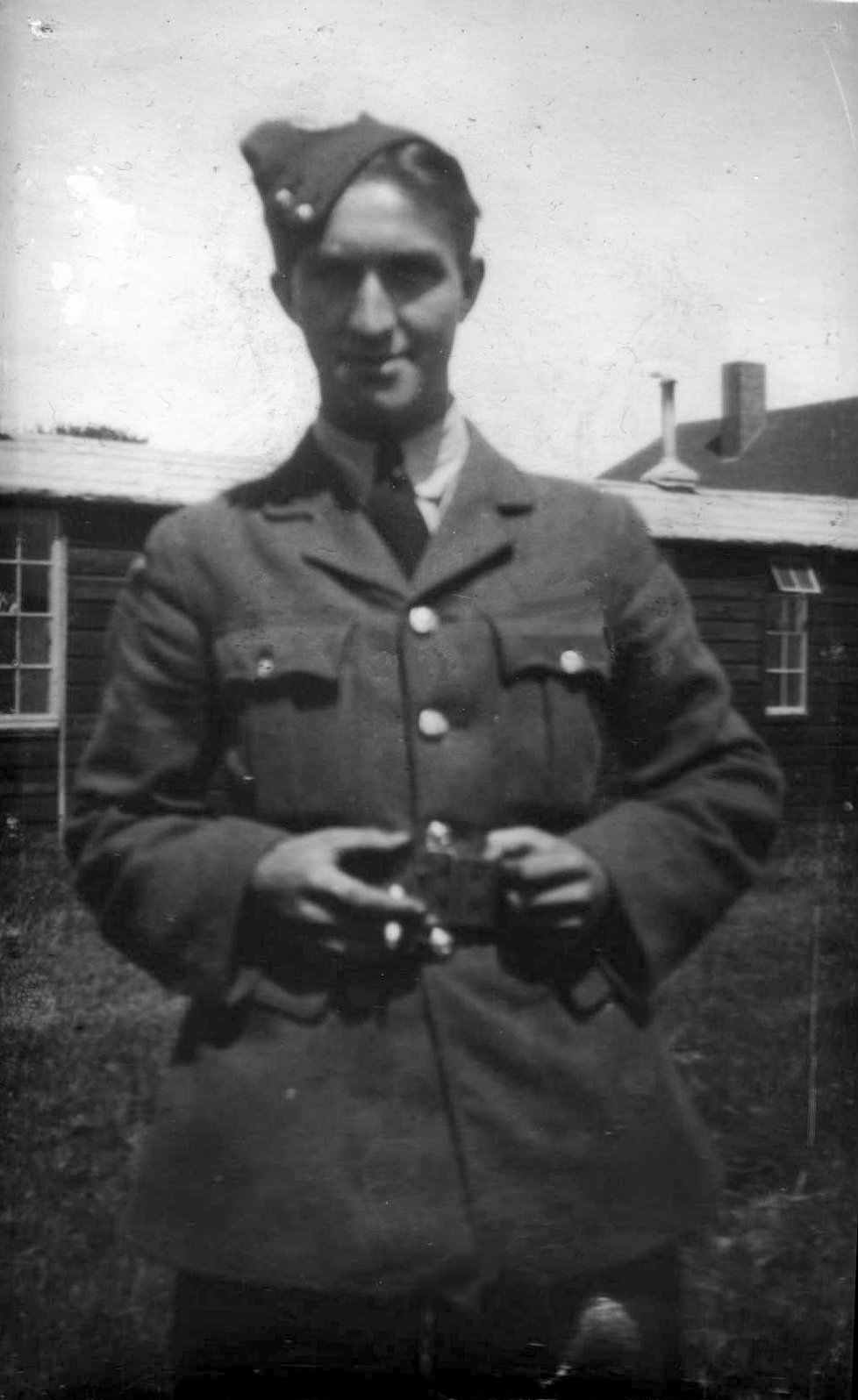

We know that there is more to tell from this period as daughter Millie and her son returned to live with Walter and Edith, escaping the London Blitz, and we hope to be able to publish more details in future.
Sadly, Walter’s wife, Edith, died during this period in October 1943.

Walter lived on until the end of 1963. He was buried in the Baptist Chapel and his funeral was reported in the local newspaper.