 As we emerged from lockdown this summer, a chance encounter on our village road with a camper van looking for directions to ‘Reeves Corner’ (now know as Cooks Corner) helped us to uncover the stories of two brothers – and their wider family members, many of whom left the village almost a century ago.
We are indebted to Max Wurr, a great-great nephew of Charlie and William (Billy) Reeve, who has taken on the mantle of family historian and provided us with most of the wonderful photographs shown here and some lovely anecdotes passed down the generations – things that you can never find in the official records.
Charlie (as he was always known by the family) was born on the 25th of January 1896 in Carleton Rode and baptised in All Saints’ Church two months later. The confusion over dates in the baptismal register reflects what must have been a terrible time for the Reeve family.
Charlie’s mother, Mary Heavers Reeve, had given birth just fifteen months previously – a boy they named Harry Oliver (although he appears as Henry in the church register). Clearly, Harry must have been seriously ill by this point as his parents had him baptised on the 20th of March; he lived on for just another week. We can only imagine how distraught the family must have been and Charlie’s baptism on the 26th of March (the day before Harry’s death) was recorded as ‘PB’ – private baptism, usually performed in this period when a child was gravely ill and not expected to survive. Outbreaks of infectious diseases such as diptheria, whooping cough and scarlet fever were often reported in the local papers at the time. As this was before effective treatments or vaccines had been developed, many infants and young children died.

Middle row L-R: George, Charlie, Mary
Front: Gertie
Charlie, though, did survive and his parents, George and Mary, went on to have another child five years later. In total, the couple (who married in 1884) had seven children live to adulthood; Arthur, Edith, Frederick, William, Alice, Charles and Gertrude.
Their father, George, came from a long line of blacksmiths who had been in business in the wider local area since at least the early 19th century. They were ‘Master Blacksmiths’, serving seven-year apprenticeships, and as a small boy, George, with his father (also called George) and family had moved from Ashwellthorpe (about five miles further along the same Turnpike Road) into premises at Carleton Rode in the late 1860s.

The forge was situated at the junction with Fen Road (leading to Diss) and Church Road (leading to the main village and on towards Attleborough) – ideally situated for all local work and passing traffic. Indeed, a local farm still has door fittings made at the forge with ‘GR’ stamped on the latch. Although it is not known which George – father or son – made them.


George, after serving his apprenticeship in Long Stratton and marrying there, returned with his growing family to work with his father in Carleton Rode in the early 1890s. The business was thriving and all four of George and Mary’s sons followed in their father’s, grandfather’s and great-grandfather’s trade. George senior died suddenly in 1899 and his son, George, took over the running of the business. After completing their apprenticeships, the next generation of blacksmiths gradually moved away – Arthur, the oldest, took over the forge in neighbouring New Buckenham where he traded until the 1960s; Frederick worked for his father in Carleton Rode and then for his brother, Arthur, in New Buckenham before moving elsewhere (Roudham in the 1939 Register); William (Billy) also worked at Arthur’s forge in New Buckenham before moving to Wymondham where he lived and worked for his younger brother Charlie during the 1920s and 30s.
When George retired and moved to his daughter’s home in Sussex (c1934), and as motor transport completely overtook horse drawn vehicles, the smithy became a garage under the ownership of the Cook family. It is fascinating to contrast the photograph below, taken in about 1970, with the one above. Max Wurr remembers his mother and older brother visiting the garage on a family history trip back in the 1980s where they were shown the signature of George Reeve inscribed on a windowpane. Sadly, that too has now been lost as the garage site has been redeveloped for housing.

However, we are getting ahead of ourselves, and so to return to Charlie’s story.
Our Roll of Honour board records him as ‘G’ Reeve but after researching the family, we now know that this is a mistake (the board is a later copy) and it should be ‘C’ Reeve – Charlie was one of two Reeve brothers who served in World War 1.
After such a difficult first few months of life, Charlie not only survived but developed the strength and fitness to become a blacksmith and on the 1911 census, aged 15, he was working with his father and older brother, Fred, in the family forge. He would have completed his apprenticeship by about the age of 18 – around 1914/15 – and we know that Charlie then moved to Norwich as he was living there, in lodgings in St John Street, working as a ‘shoeing and general machinist’ when he attested into the Royal Horse & Royal Field Artillery (R.H. & R.F.A.) in February, 1916. He is described as 5’ 7” in height and of good physical development. He also had a ‘slight goitre’ or swelling in the neck – could this be a related to the disease he contracted in his first few months of life?
Following his medical examination, Charlie was then sent to Woolwich where he was assessed in the Military Workshops of the School of Farriery and subsequently appointed as a ‘skilled’ Shoeing Smith, number 123255. He was posted to France almost immediately arriving on the 17th April 1916. Click here to read about army horse care in the First World War.
His battery joined the 38th Divisional Ammunition Column and by July were in action on The Somme at Mametz Wood and suffered severe casualties. Charlie escaped physical injury, although the artillery was in continual action throughout this period. The Division were back in the thick of it during the Third Battle of Ypres (summer and autumn of 1917), they fought through the Second Battle of the Somme (spring of 1918) and the Battles of the Hindenburg Line later that year. This latter, massive Allied offensive was to prove decisive in bringing the war to an end and led to the Armistice of November 11th, 1918. Charlie, coping with harrowing events on the front line, was also having to come to terms with sadness at home too.
His mother, Mary, died in early April 1917, aged 61, and she was buried in Carleton Rode cemetery. No doubt when news reached Charlie, he requested time to visit his family as he was given 10 days’ leave in May.
The following entry can be found in the parish magazine from June of the same year:
Tidings also come to us from other Carleton Rode Boys. We were pleased to see Charlie Reeve, home from France on short leave in his old place in the choir on Rogation Sunday. Many are suffering from wounds at home and abroad, and two for a long time have been missing and hope grows faint. Our earnest intercessions for all who are in anxiety and sorrow.
Another facet of Charlie’s character is revealed – he had a good voice and presumably enjoyed singing! Our correspondent, Max Wurr, whose great grandmother was Charlie’s older sister, Edith (who left the village around 1906 to go into service with a titled family in Sussex) tells us the following:
“There is the odd bit of dialect or a saying that reached down the generations and I still say “hello hay” for luck if I see a hay wagon on the road, which my mother used to say came down to her from her grandmother Edith. The only real tale that sticks out for me was when one of Edith’s brothers (I have an inkling it was Charlie) came down from Carleton Rode to visit her while she was Lady’s Maid at The Warren House in Broadwater in Sussex, which would have been before 1909. Presumably ravenous from the journey, he tucked into a frugal meal of bread and milk, spilling much of it on the table, for which Edith reprimanded him (she was after all a lady’s maid). Not impressed with her new-found airs, he retorted in his thick Norfolk, “I didn’t come down ‘ere to be criticised by you, Edie!” It’s not much of a tale, admittedly, but it gives a little life to the characters and lives on in our family mythology. Indeed, the phrase is still rolled out when someone needs bringing down a peg or two!”
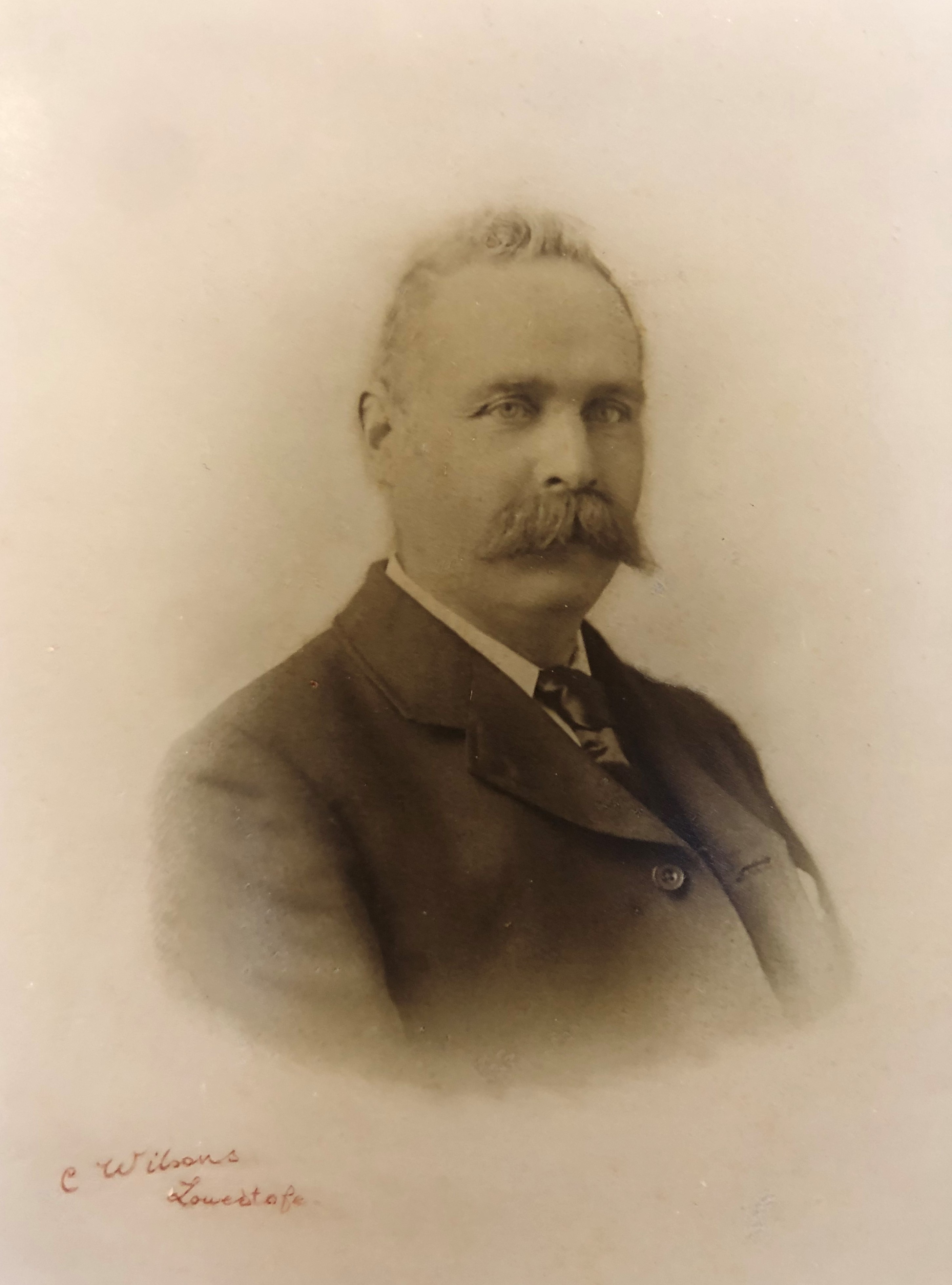
I think we can also say, judging by the photograph that Max provided of Charlie as a young man, that he was a dapper dresser too – the epitome of a country gent!
We also learn from his service record that Charlie was an efficient and well-regarded soldier – awarded Proficiency Pay Class I and made a Staff Sergeant by the end of the war. He continued to serve in France and then in Germany after the Armistice until he was discharged in September 1919. He returned to Carleton Rode and resumed life working with his father.
In October 1924, Charlie married Freda Ethel Large in All Saints’ church, Carleton Rode, the daughter of a Bunwell farmer. The couple had three children over the next six years – Audrey, George and Helen – and by the 1930s, Charlie had established a farrier business on Fairland Street in Wymondham which later became C E Reeve Agricultural Engineers.
During the Second World War, Charlie volunteered for the Observer Corps in the town; perhaps not as well known to us today as the other volunteer units such as the Home Guard or the ARP Wardens but it played a vital role in recognising and reporting enemy aircraft crossing overhead. This is something that needs further research and we would welcome more information.
Charlie died in 1960. Freda lived on in Fairland Street until her death in 1979. We are hopeful that descendants of Charlie and Freda will get in touch through the website.