
 Herbert was born on the 8th October, 1895, in Wacton, Norfolk, to Robert and Betsy Saker – their sixth child and fifth son.
The following is an account of what we know of the Sakers’ life before they arrived in Carleton Rode.
Robert and Betsy had both known hardship in their early lives.
Robert James Saker was born in 1867 in Sotherton (near Wenhaston), Suffolk, to John Saker, an agricultural labourer, and his wife Lydia. Aged just 6, both of Robert’s parents died within a day or two of each other, and they were buried on the same day, the 15th April, 1874, in St Peter’s churchyard in Thorington, Suffolk. Robert was then sent to the Blything Union Workhouse where he would stay until he was 13 (and he is listed as an inmate on the 1881 Census). This workhouse had a reputation for being particularly severe. However, the alternative would probably have been starvation. This was the time commonly known as ‘the great depression’ in agriculture – rural poverty, malnutrition, and disease were rife. At least Robert survived. He received a basic education during his six or seven years in the workhouse and on reaching working age, would have been found agricultural work in the area.

His future wife, Betsy Calver, was born in 1864, the daughter of a rat catcher living at Dorley’s Corner, near Kelsale. She probably left school at 12 and on the 1881 Census is working as a live-in domestic servant with a farming family in Aldringham, a village further east towards the coast about three miles from Aldeburgh. However, in the summer of 1886 she had returned to the family home and given birth to an illegitimate child, Martha Calver. Was this Robert’s child? We simply don’t know – but the couple married in mid-1888 and Martha took Robert’s surname. They lived in Kelsale for the first three years, where two more children were born, before moving into South Norfolk.
Four more children were born during the years before the family moved to Carleton Rode in 1898 – John (13.12.1893), Robert (16.10.1894), Herbert (8.10.95), and Lily May (4.9.1897). The school log records five children were admitted in October of that year – Martha, Maurice, James, John and Robert. ‘M Saker’ is reported to the Attendance Officer less than a month later (Martha or Maurice?) Six more children were born over the next decade; Ernest Edward (12.9.1899), Rosa (or Rose, 10.10.1900), Betty (or Bessie, 22.10.1901), Charles (sometimes called Carlos, 16.2.1903), George (23.4.1907). Mabel Louisa’s birth and death are registered in the same quarter of 1908 when Betsy would have been 42.
On the 1901 Census, Robert (father) is listed as blind, and the family were probably in receipt of parish relief (‘pauper’ can still be read on the form). His occupation had previously been recorded as a hawker and a few years later he has an entry in Kelly’s Directory for 1908.
The children’s birthplaces (those born in the 1890s after they left Woodton) reveal that the family moved on a regular basis; Wacton, Pulham – possibly the Workhouse, then back to Wacton before finally settling in Carleton Rode in 1898. By 1911, there was also a Blanche Saker, named as a granddaughter aged 6, born in the village and living with the family in a cottage on the Mile Road.
Herbert Saker 1895 -1978
We know from Carleton Rode school records that Herbert was awarded a prize for regular attendance in 1906 (not always the case for his siblings!) and that he left school in October 1908, on reaching his 13th birthday. By 1911, he was living at The White Horse pub in Old Buckenham and working as an ostler where he would have been responsible for stabling and caring for the horses kept at the inn (now The Gamekeeper).

The next clues to his early life are found in his RN Service Record. He joined the Royal Navy at 18 in June 1914 when he signed up for 12 years, giving his occupation as gardener. His two older brothers, John and Robert, has signed up the previous February – clearly the Navy offered the boys better opportunities than agricultural work. When war was declared only 2 months later, Herbert was training at his base port, Pembroke II, which was at Chatham at this time. Herbert was a Stoker aboard HMS Halcyon from October 1914 to May 1915 – a ship that one of the older brothers previously mentioned (John) was also aboard as a stoker.
Originally a torpedo gunboat, the Halcyon was converted to a minesweeper at the start of the war and stationed at Great Yarmouth. She was the flagship patrolling the North Sea port and town on the 3rd November 1914 when the German Navy attacked with two squadrons of battleships. At the start of the ‘Raid on Yarmouth’, the Halcyon immediately engaged with the enemy and came under heavy fire during which at least one seaman aboard was killed. Other destroyers arrived in support and although it is not regarded as a major naval engagement, 235 men were killed in this action.
The following year, Herbert returned to base at Chatham before joining HMS Lynn (not certain as it is difficult to decipher the handwriting!) in June 1915 and spending six months at sea, returning in December that year. He was invalided out the following February with Tuberculosis – the family also know that he sustained leg injuries during his naval service.
We are very grateful to Keith and Ian Saker, grandsons of Herbert, who have kindly provided us with details of Herbert’s later life and that of his sons.

After leaving the Navy, Herbert met Violet Elizabeth Pottage (born Beverley, Yorkshire on 22nd August 1896) when they were both working in a London munitions factory. They married on April 6th 1918 in All Saints’ Church, Carleton Rode – the register reveals that Herbert was a munitions worker at the time and it seems likely that they met in the Park Royal Munitions Works, Willesden, close to Stonebridge, north west London (Violet’s residence at the time of her marriage). The area had several munitions factories employing several thousand women; the fewer numbers of male workers were mainly those who were not fit enough to fight on the front line. The district was bombed in 1917 – so perhaps that is when Herbert returned to Norfolk and Violet followed. Click here to learn more about the lives of munitions workers during the First World War.
Herbert and Violet had their first child, whom they named Herbert, on the 4th March 1919 and he was baptised in St Philip’s Church, Heigham two months later. The couple were living in 1 Dapling’s Buildings on West Pottergate in Norwich and Herbert was employed as a boilermaker’s assistant (no doubt using the skills he’d acquired as a stoker in the Royal Navy). Their second son was born on the 1st September, 1921, and they named him after Herbert’s two brothers who had died from war injuries – Ernest James Saker (known as Ernie). He was also baptised in St Philip’s, Heigham and his father, Herbert, continued to work for the railway as a boiler maker.

The family lived in West Pottergate for the next few years with Herbert still labouring on the LNER in Norwich. Their third son, Robert John (Bob) was born on the 25th April 1925 and, like his older brothers, was christened in St Philip’s Church. This once great Victorian church (which stood just to the west of Pottergate Street) was declared redundant in the 1970s and demolished. However, the photograph reproduced here was taken by George Plunkett in 1962 – a remarkable man who, after acquiring a box camera in 1931, began to document the changing face of the city and continued to do so until 2006. His outstanding archive can be viewed here.
The 1930s was a time of great change in the city when many of the old inns, yards and courts were demolished, including a large area between Pottergate and St Benedicts. Although unsure of the exact location of Dapling’s Buildings where the Sakers lived, more information can be found in the excellent publication, The Old Courts and Yards of Norwich by Frances and Michael Holmes and published by Norwich Heritage Projects.
A few years after the birth of Bob, the family moved from West Pottergate Street to York Street, off the Unthank Road. All three sons served as choir boys at St Peter Mancroft, Norwich’s magnificent civic church next to the market place.

The 1939 Register, compiled at the start of the Second World War, gives an insight into their lives at 19 York Street. Herbert, in his mid-40s, was described as a ‘caller-up’ on the LNER (some kind of timekeeper role?), son Herbert, aged 20, was an apprentice chemist in the pharmaceutical industry, Ernie (at 18) was the ‘Third Cinematographic Operator’ at the local cinema, and Bob was a 14-year-old office boy at the Iron Works. Their mother, Violet, in common with most married women at the time did not go out to work. The BBC’s WW2 People’s War website – now archived – has interesting eye-witness accounts of life in the city, including a couple who were bombed out of their home on York Street.
Herbert, a keen gardener, was very proud of his allotment. He and Violet also had a holiday chalet bungalow in the dunes overlooking the sea at Hemsby where the family would congregate during the summer. Sadly, a few years after the bungalow was sold, coastal erosion took its toll and now the site of the bungalow is several feet under the sea.
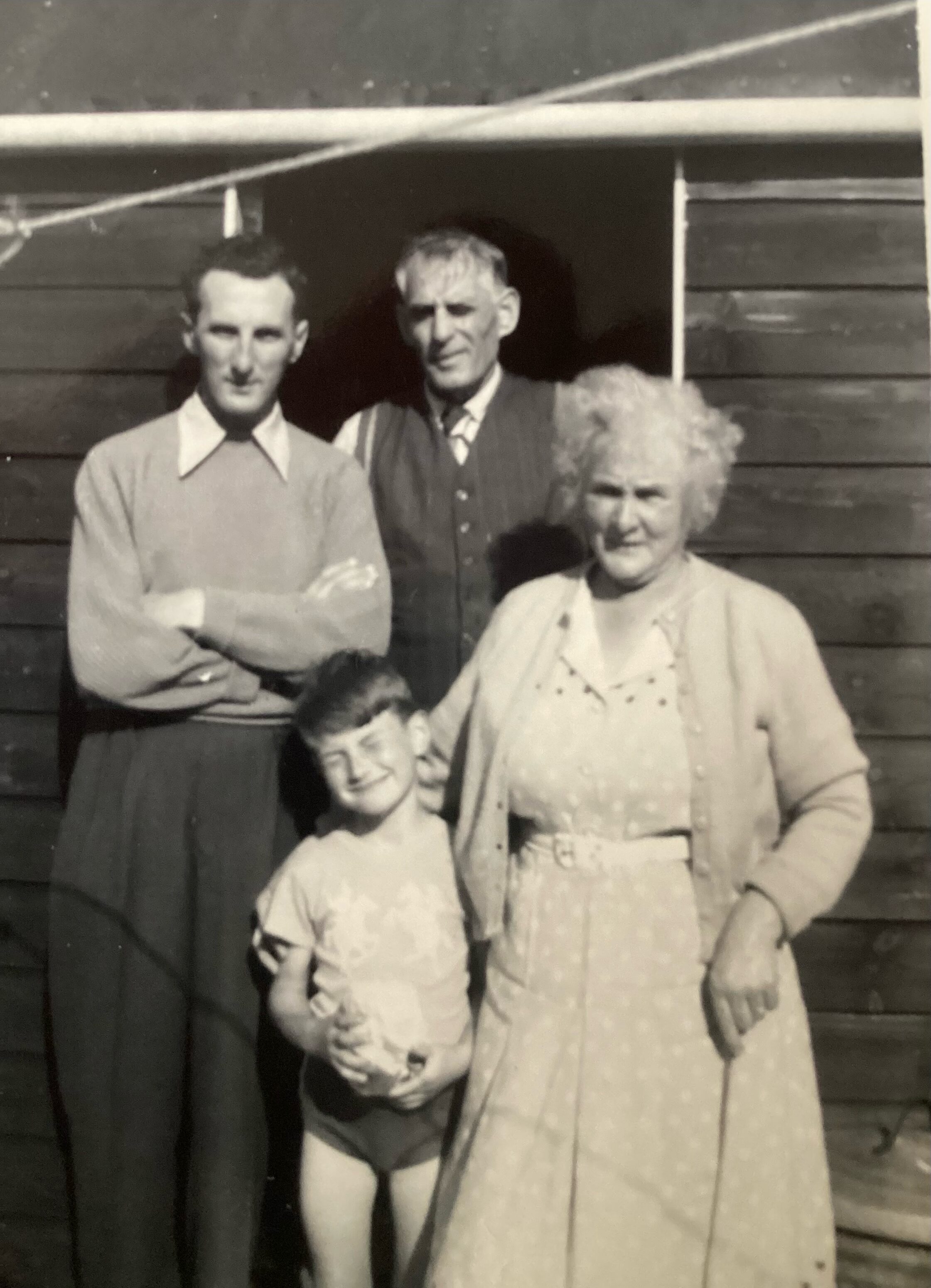
Herbert retired in 1960 and spent the rest of his life at York Street until his death on 1st May, 1978. Violet, known fondly by Herbert as Mopsy, died on 22nd January 1988.
In the words of their grandsons, Keith and Ian, “They were caring and loving people and we were fortunate to spend so much of our life with them.”
Herbert and Violet’s three sons all served in World War 2. We are grateful to Keith and Ian for the following potted biographies.
Herbert
Herbert was often known outside of close family as Jim, especially in his working life. He attended the City of Norwich Boys School and went on to study Pharmacy at Leicester Tech in the early 1940s. Qualifying during the war years, he subsequently joined the Royal Army Medical Corps as a Sergeant. Herbert served on hospital trains taking wounded servicemen from the south coast to safer destinations in the north of England and Scotland. He also served in India as a medic in Italian prisoner of war camps. He met Dorothy Lewis after discharge from the army and they married in 1944 and subsequently moved to Bedford where their only child Ian was born. Herbert spent all of his working life employed by Boots the Chemist. He worked at shops in Norwich, Leicester and also London, where he managed several branches of Boots. Herbert retired in 1978 and he and Dorothy moved to East Runton in North Norfolk where they lived until 1986 and then relocated to Glenfield, Leicester. Herbert died on 2nd December 2008 and Dorothy died on 18th May 2012.
Ernie
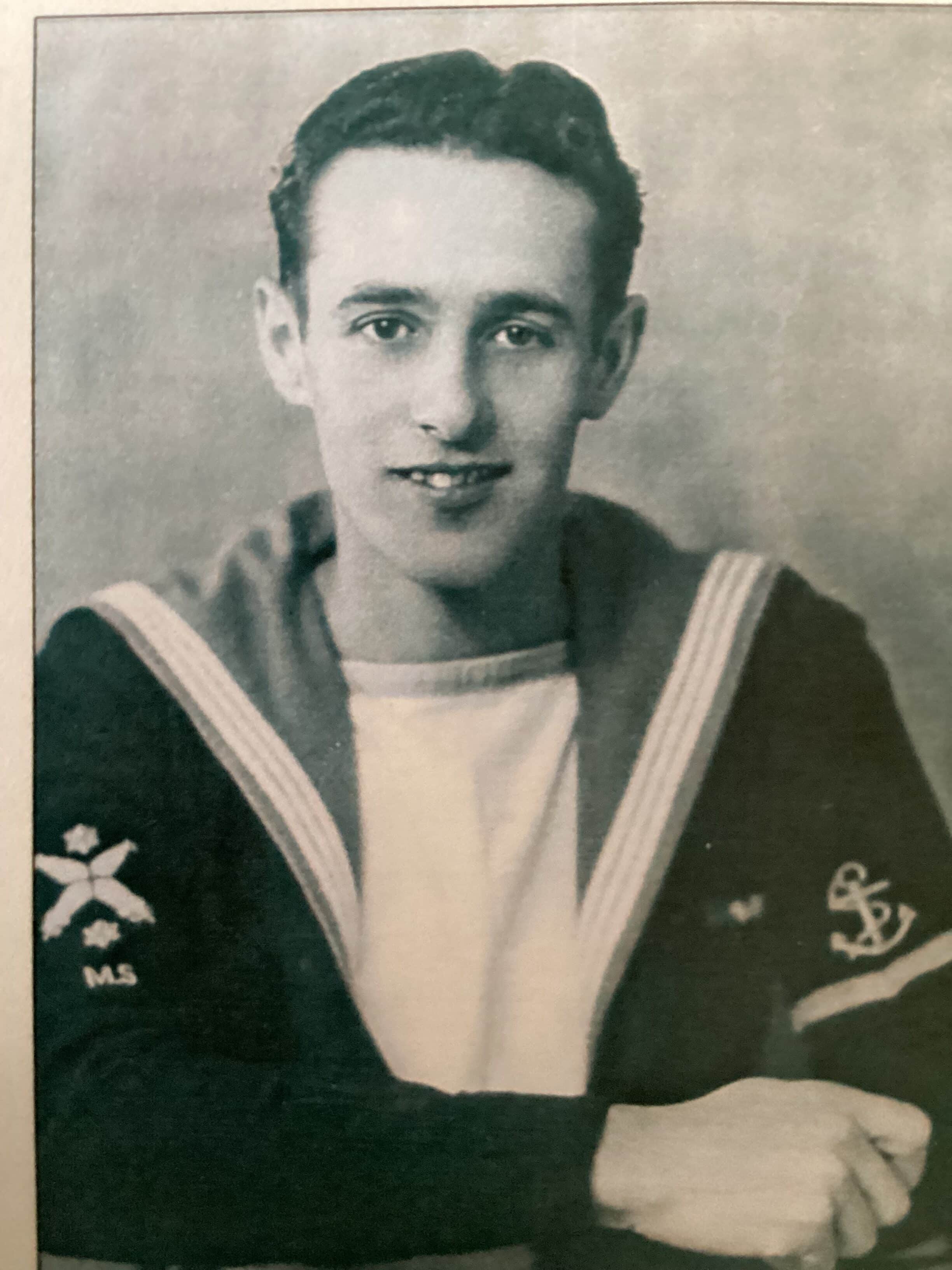

Ernie joined the Navy during the Second World War and served on minesweepers. In 1946 Ernie married Beryl Saker in Portsmouth before moving to Bury St Edmunds where he worked as a projectionist in the local cinema. He and Beryl emigrated to New Zealand on the TSS Captain Cook in February 1958. Ernie took up a similar position with the local cinema in Napier, a city on the east coast of North Island. Later he worked for the local council as a hydatid officer, ensuring the well-being of working dogs on the sheep farms around Napier. Ernie was a senior soccer referee in New Zealand and officiated at the Chatham Cup Final (our equivalent to the FA Cup) in the 1971 final between Western Suburbs FC and Wellington City.
Ernie died in Napier on 1st September 2008 and his wife Beryl died there in 2011.
Bob
Robert went to Avenue Road school and during his school years was very keen on sport, going on to play football for Norwich boys while captaining Norwich boys’ cricket eleven. He joined the Royal Air Force in 1943 and trained as an Air Gunner before moving on to parachute training where he became a parachute instructor and was promoted to Flight Sergeant.
After Bob was demobbed in April 1947, he joined Barnards, an iron foundry business based on the Salhouse Road in Norwich. He married Barbara Peggy Lutkins in Norwich in March 1950 and two years later (in June 1952) they had their first child, Keith. Two years later, they moved to Thorpe where their second child, Kevin, was born in November 1959. Bob, like his elder brother Ernie, was also a prominent member of his local lodge in Norwich. Bob joined Vitretex, a paint manufacturer, as depot manager in the late 1950s. He became the area manager and remained with the company until his untimely death on 23rd July 1973. His wife, Barbara, died in January 2009.
Herbert Saker is my grandad and I would welcome the opportunity to share details of his life with you. I would also appreciate more information about his parents, Robert and Betsy.
Kind regards
Keith Saker