 Robert was born on the 16th October 1894, and he later gave his birthplace as Harleston (although on the census returns of 1901 and 1911, it was recorded as Pulham – both were in the Depwade registration district where his birth was indeed registered in the last quarter of 1894).
The Saker family moved to Carleton Rode in 1898 and Robert, along with his brothers Maurice, James, John and sister Martha, were admitted to the school in early October of that year – just short of Robert’s fourth birthday. For an account of the previous history of the Saker family, click here.
Robert left school on the 7th of October, 1907, following their receipt of a Labour Certificate for him from W Thompson (presumably a local farmer). Robert was engaged in farm work and living with his parents on the Mile Road in Carleton Rode when the 1911 census was taken. However, this was a time of great hardship for agricultural workers with very poor wages and limited prospects, and three of the older Saker sons joined the navy; John (at the beginning of February, 1913), Robert (two weeks later) and Herbert (in June, 1914). On his naval record, Robert was working as a coal porter when he signed up.

Following enlistment, Robert was sent for six months training to HMS Victory II (at Crystal Palace, Sydenham), a shore-based establishment specifically for stokers (STO) and engine room artificers (ERA). He was then posted to HMS Albermarle, a gunnery training ship. Within a year, he was promoted to Stoker 1st class and joined HMS Pyramus, three months before the outbreak of World War 1.
The ship was moored in Wellington, the port city at the southern tip of North Island, New Zealand, and from there they sailed to Fiji, an allied territory, before heading to German Samoa, where they landed and demanded the surrender of the Governor; there was no opposition. The crew hoisted the Union Jack flag over the municipal buildings on the island and then headed back to Australia, hosting gunnery training and supporting ships as required.
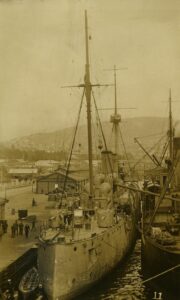
In October, the Pyramus docked in Hobart (Tasmania) where she was fitted with torpedoes and the crew received the relevant training before heading off on defence duties; Freemantle to Singapore, then Penang (Malaysia), Ceylon (Sri Lanka), Bombay (India), Mombassa (Kenya), Zanzibar and Tanzania, which had effectively been a German colony since 1880 (part of German East Africa) and down to South Africa. The ship is involved in many skirmishes whilst patrolling the German held coast, and in transporting prisoners-of-war. There are several casualties during 1915, both on board during firing at sea as well as onshore actions. The ship also received bodies for burial at sea from other ships, notably HMS Juno (on which his older brother John would serve the following year).
In August 1915, the Pyramus was sent to the Middle East region: Bahrain, Qatar, and Iran. The ship was engaged in continuous patrol of the coastal areas; the Persian Gulf, the Gulf of Oman – and further on to what was then British India – until the middle of 1916 when all hands were ‘paid off’ and transferred elsewhere.
After a few months back at his Crystal Palace shore base, Robert was sent (at the beginning of 1917) to HMS Petunia in the Mediterranean. She was a minesweeper and a tender for HMS Egmont, which was a shore base in Malta, and HMS Cormorant, a shore base in Gibraltar. He was on the Petunia until April 1919, and then transferred to the Centurion, which was part of the Mediterranean Fleet and was also part of the Allied intervention in the Russian Civil War. Robert was eventually returned to shore base at Portsmouth in mid-1921, he married a young war widow, Eliza Mary Gill.
Eliza, (nee Elmes), was born in 1892 and brought up in Portsmouth, the daughter of a beer retailer trading from home. The family lived very close to the docks at Portsmouth and Eliza assisted in her father’s business. She married Able Seaman Robert Gill in 1912. Having started as a boy cadet, Robert had already spent twelve years in the RN. They had a son, Robert Victor Gill, born on the 30th October, 1913.
At the beginning of the First World War, Eliza’s husband, Robert, was sent to HMS Maidstone, a purpose-built submarine supply ship. She was the principal depot ship for the 8th Submarine Flotilla based out of Harwich and on which he was deployed for the next two years before transferring to service on the submarines themselves. Robert was aboard the K17 submarine in January 1918 when she was accidentally sunk on night-time exercises by an escorting cruiser. All hands were lost.
Eliza was left a widow with a young son – and it is not difficult to imagine that when Robert Saker met Eliza Gill, they would have had much in common; lives that revolved around naval service and all that it demanded.
Robert and Eliza went on to have two children together, Dennis Ernest James Saker born late in 1922 (Ernest and James were the names of Robert’s two brothers who had died during or just after the war), and Beryl Doreen Saker in 1924.
Robert remained in the Royal Navy for the next sixteen years. He was made a Stoker Petty Officer in 1926, received his Long Service and Good Conduct Medal in 1928 (whilst aboard HMS Argus, an aircraft carrier) and promoted to Chief Stoker in 1932. He was pensioned in February 1935, having served for 22 years – although, his life on civvy street didn’t last long as was immediately recalled at the start of the Second World War just over four years later.

Following a period of retraining, he was back as a Chief Petty Stoker on the refitted aircraft carrier Argus, now classified as a Target Aeroplane Carrier, where he would spend the next five years – details of those extraordinary times can be read here.
Tragically, Robert Victor Gill, was killed during WWII. Like his father and stepfather, Robert had also joined the Navy and was an Engine Room Artificer on the submarine HMS Orpheus when she was lost in a minefield off the coast of Libya in June 1940. It is difficult to imagine the trauma of these events, especially for his mother, Eliza – and the constant stress and anxiety as her husband Robert served throughout the war.
However, survive he did – Robert was finally released from the Navy on the 13th August 1945, aged 50. Putting aside the terrible cost in human life, witnessing the changes Robert would have experienced, from enlistment in 1913 to the end of the Second World War (from pre-WW1 battleship to WWII Aircraft Carrier) must have been remarkable.
So, what happened to the Saker family post-war? We have not been able to trace their eldest son, Dennis – and so are hoping descendants will find this website in the future.
We are fortunate that the grandsons of Robert’s brother, Herbert, (cousins Keith and Ian Saker) have provided the following information.
Their daughter, Beryl married her cousin, Ernest James Saker (known as Ernie, and Herbert’s son) and the couple emigrated to New Zealand in 1958. (More information on Herbert Saker’s page – click here.) Robert and Eliza went to live with them there; interesting to speculate whether Robert remembered his naval service in Wellington during the First World War.
Robert died in 1973 aged 79 and Eliza died in 1982 aged 90.